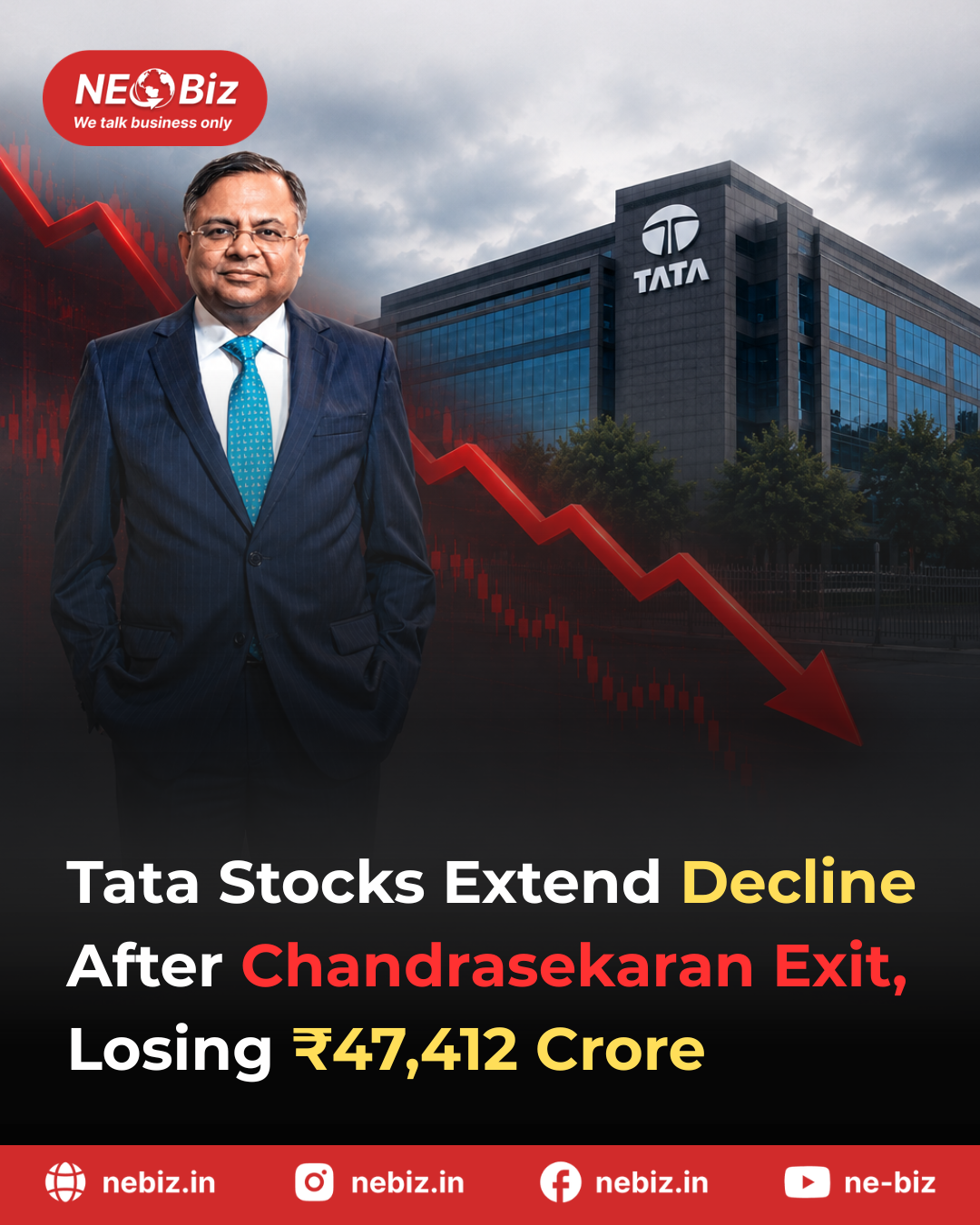
Tata Group stocks continued to face selling pressure on Thursday as investors digested the impending leadership transition at the conglomerate following N Chandrasekaran’s decision not to seek another term as Tata Sons chairman. His planned departure marks a significant change at the top of one of India’s most prominent business groups and has prompted the market to closely assess what the transition could mean for Tata’s long-term strategy, investment priorities and ongoing expansion plans.
The pressure on Tata stocks comes after a sharp decline in their combined market value in the previous session. On Wednesday, 26 listed Tata companies collectively lost around ₹47,412 crore, reflecting a cautious response from investors following the news of Chandrasekaran’s exit. Several heavyweight Tata names, including TCS, Titan, Tata Steel, Trent, Indian Hotels and Voltas, remained under pressure as the broader sentiment around the group weakened.
The market reaction has also brought renewed focus on the scale of the leadership change. Chandrasekaran has been at the helm of Tata Sons since 2017 and has overseen a period marked by significant investments, restructuring and expansion across multiple sectors. His tenure has included major moves across technology, automotive, electronics, aviation, infrastructure and other strategic businesses, making the question of succession particularly important for investors.
Despite the broader weakness across Tata counters, Tata Motors moved differently, gaining after the company reported strong quarterly results. The divergence highlights how company-specific earnings and operational performance continue to influence individual Tata stocks even as investors assess the wider implications of the leadership transition.
Chandrasekaran is expected to remain in the position until his current term concludes in February 2027. Until then, attention is likely to remain focused on the succession process, the eventual leadership structure at Tata Sons and whether the group’s ongoing investment and growth initiatives will continue at the same pace.
For investors, the development represents more than a change in leadership. The transition comes at a crucial stage for the Tata Group, with several large-scale projects and businesses entering important phases of expansion. How the conglomerate manages the succession and maintains strategic continuity could therefore remain a key factor influencing market sentiment toward Tata stocks in the months ahead.